
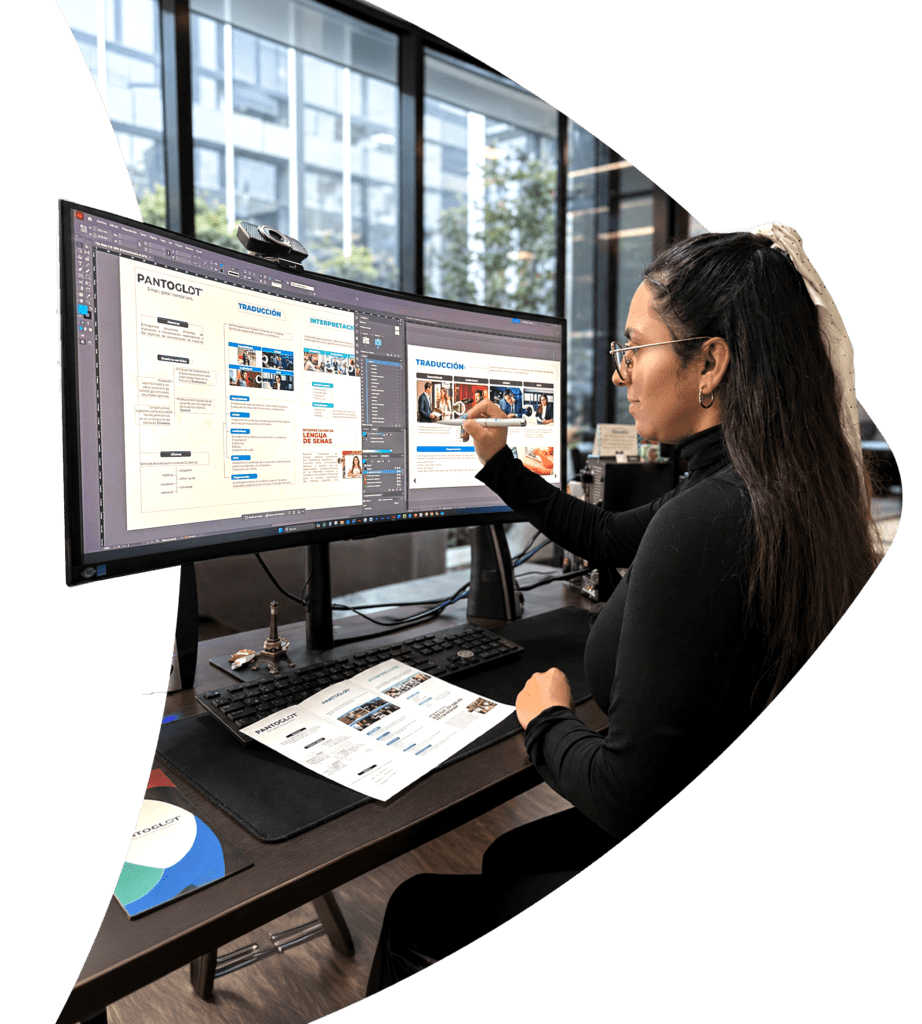
Multilingual File Prep and Document Layout
SERVICE MODELS
What is Multilingual Document Layout?
Multilingual document layout consists of adapting document design prior to and after translation to ensure document content is fully visible, legible, consistently presented and aesthetically appealing in all languages.
It is especially important when translating manuals, catalogues, reports, presentations and other business materials where text expansion or contraction can change the visual presentation of the document.
Target file document layout
We adapt document layout of translated files to preserve the original presentation in the target files ensuring all text is fully visible, legible, consistently presented and aesthetically appealing. The effect of text expansion and contraction is smoothed out in final DTP, typography is optimized and original design integrity is preserved to ensure user experience in any language is aligned with your expectations.
What you can expect:
- Adjust translated content to smoothly work in existing design
- Adapt for text expansion and contraction
- Preserve design integrity of font types, font sizes, styles, margins, headers, footers, headings, sub headings, graphs, tables, images and any other graphical elements
- Visual quality review of the final target language design copy
- Files ready for print or digital publication
When to use this service:
Manuals, catalogues, reports, business documents and organizational content presented in multilingual format.
File preparation for translation
Professional designers use OCR and AI tools as appropriate depending on the source files(s). Once prepped, files are optimal to the flow through an augmented translation process where human linguists work with CAT technology and todays leading LLMs.
Augmented file prep is supported by AI quality checks to ensure veracity of non-translatable content.
Numbers, alphanumeric codes, proper names and layout are preserved.
What you can expect:
- File layout correction, organization and appropriate use of styles
- Proper translation unit segmentation
- CAT tool compatibility
- Identification of non-translatable content
- Optimization for injection into multilingual workflows
Correct file preparation reduces costly reprocessing, optimizes turnaround times and improves linguistic experience allowing language professionals to focus on great translations. It also contributes to efficient multilingual content management and higher quality target files.
File conversion
PDF conversion to Word or other original file format is also a standard pre-translation process. This conversion is done to deliver editable files to linguists who focus on translation not document layout. The conversion is supported by high powered OCR and AI tools to ensure translated documents are print ready with little effort after the translation process. Our file prep process checks technical compatibility to ensure files move efficiently through workflows, reducing costly incidents that can delay projects.
What you can expect:
- Conversion to editable and print ready formats: PDF, InDesign, Word, PowerPoint
- Standardization of styles, font specs and document structure
- Technical validation of the final source file format prior to translation
File conversion and standardization aids in multilingual project management. It helps avoid technical problems that can affect the final result. Properly prepped files flow efficiently through the translation process, while maintaining file integrity and easing the translation experience.
STRUCTURE AND CONTROL
A Complete Technical Process for Multilingual Files
Each project is submitted to a structured workflow that guarantees visual integrity, file compatibility, and appropriate file layout in all languages and file formats.
Initial technical analysis
We review file format, structure, layers and possible risks prior to prepping for multilingual layout.
Adaptation and file layout
Adapt target file design to account for text expansion or contraction, preserving styles and legibility.
Conversion and compatibility
Standardize files to ensure they function as expected in different platforms, tools and publishing environments.
Final file check
and delivery
Questions?
Tell us about your project, and we will guide you to a solution that best meets your need.
FILE MANAGEMENT
Multilingual File Prep and Document Layout
- Prepare source files for translation
- Adapt target file design to account for text expansion or contraction
- CMS, e-Learning, web and other platform layout and design
- Files ready for print or digital publication
SERVICE MODELS
What is Multilingual Document Layout?
Multilingual document layout consists of adapting document design prior to and after translation to ensure document content is fully visible, legible, consistently presented and aesthetically appealing in all languages. It is especially important when translating manuals, catalogues, reports, presentations and other business materials where text expansion or contraction can change the visual presentation of the document.
Target file document layout
We adapt document layout of translated files to preserve the original presentation in the target files ensuring all text is fully visible, legible, consistently presented and aesthetically appealing. The effect of text expansion and contraction is smoothed out in final DTP, typography is optimized and original design integrity is preserved to ensure user experience in any language is aligned with your expectations.
What you can expect:
- Adjust translated content to smoothly work in existing design
- Adapt for text expansion and contraction
- Preserve design integrity of font types, font sizes, styles, margins, headers, footers, headings, sub headings, graphs, tables, images and any other graphical elements
- Visual quality review of the final target language design copy
- Files ready for print or digital publication
When to use this service:
Manuals, catalogues, reports, business documents and organizational content presented in multilingual format.
File preparation for translation
Professional designers use OCR and AI tools as appropriate depending on the source files(s). Once prepped, files are optimal to the flow through an augmented translation process where human linguists work with CAT technology and todays leading LLMs.
Augmented file prep is supported by AI quality checks to ensure veracity of non-translatable content.
Numbers, alphanumeric codes, proper names and layout are preserved.
What you can expect:
- File layout correction, organization and appropriate use of styles
- Proper translation unit segmentation
- CAT tool compatibility
- Identification of non-translatable content
- Optimization for injection into multilingual workflows
Correct file preparation reduces costly reprocessing, optimizes turnaround times and improves linguistic experience allowing language professionals to focus on great translations. It also contributes to efficient multilingual content management and higher quality target files.
File conversion
PDF conversion to Word or other original file format is also a standard pre-translation process. This conversion is done to deliver editable files to linguists who focus on translation not document layout. The conversion is supported by high powered OCR and AI tools to ensure translated documents are print ready with little effort after the translation process. Our file prep process checks technical compatibility to ensure files move efficiently through workflows, reducing costly incidents that can delay projects.
What you can expect:
- Conversion to editable and print ready formats: PDF, InDesign, Word, PowerPoint
- Standardization of styles, font specs and document structure
- Technical validation of the final source file format prior to translation
File conversion and standardization aids in multilingual project management. It helps avoid technical problems that can affect the final result. Properly prepped files flow efficiently through the translation process, while maintaining file integrity and easing the translation experience.
STRUCTURE AND CONTROL
A Complete Technical Process
for Multilingual Files
Each project is submitted to a structured workflow that guarantees visual integrity, file compatibility, and appropriate file layout in all languages and file formats.
Initial
technical analysis
We review file format, structure, layers and possible risks prior to prepping for multilingual layout.
Adaptation and file layout
Adapt target file design to account for text expansion or contraction, preserving styles and legibility.
Conversion and compatibility
Standardize files to ensure they function as expected in different platforms, tools and publishing environments.
Final file check
and delivery
layout QA
before it is
released to print or
digital publication.
Questions?
Tell us about your project, and we will guide you to a solution that best meets your need.